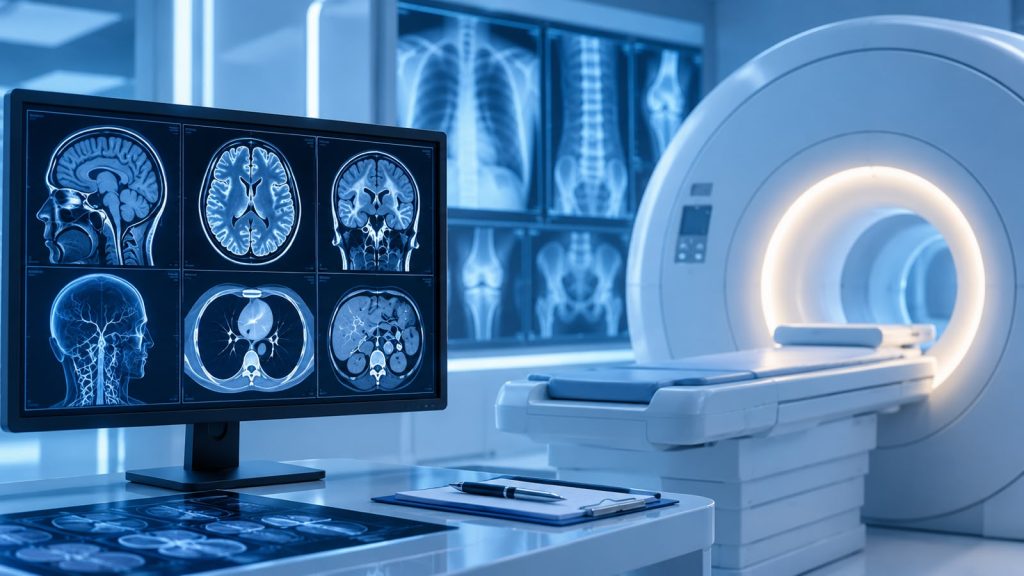
Getting a CT Scan or an MRI are on the most commonly used imaging tests in healthcare. and most of us have heard about them and know that both these scans require patients to lie on a movable table that passes through a big, donut-shaped machine. But do you know what exactly is the difference between them and how do doctors decide which one is the right choice?
Both CT scans and MRIs create detailed images of the body’s internal structures, which helps doctors diagnosing an illness, investigating unexplained symptoms, monitoring treatment progress, or detecting conditions such as cancer. However the key difference lies in the technology used in the process. Computed Tomography scans, known as CT scans, use a series of X-rays taken rapidly from multiple angles around the body. These images are then combined to create detailed, three-dimensional views of organs and bones. On the other hand, Magnetic Resonance Imaging, i.e, MRI uses a powerful magnet and radio waves that interact with molecules in the body, producing signals that help create highly detailed images of different tissues in our body.
Doctors recommend either CT scan or MRI based on the diagnostic information required.CT scans excel at spatial resolution, meaning they are particularly effective at showing the shape, size, and boundaries of structures within the body. They help doctors clearly identify where one structure ends and another begins. MRIs, meanwhile, are known for their superior contrast resolution, allowing them to distinguish between different types of soft tissues more effectively. This makes it easier to identify subtle differences between normal and abnormal tissue.
Moreover CT scans are often preferred when evaluating bones or when a quick assessment is required. As the scan is much faster than an MRI it is particularly useful for patients who are in pain or may find it difficult to remain still for extended periods. MRIs often take anywhere between 30 minutes to an hour, but they can provide more detailed information about soft tissues and are frequently used when doctors need a closer look at an area of concern.
Certain medical conditions may also influence which imaging method is chosen. For cancer diagnosis, CT scans are useful in imaging bone and air filled spaces and is often used in Lung cancer, pancreatic cancer and bone cancer whereas MRIs provide superior soft-tissue contrast without using radiation which is useful in spotting tumours in Spinal cord and Brain, Breast cancer and Prostate cancer.
The presence of metal implants, pacemakers, prosthetics or foreign objects embedded in your body may also influence the imaging procedure recommended by your healthcare provider. Since a very powerful magnet is involved in MRI, if the patient’s body has anything ferro-magnetic (iron-based), it could become dislodged and move around inside your body during an MRI.
Although both scans provide valuable diagnostic information, neither is inherently better than the other. Instead, they are complementary tools that offer different types of insights.. While they differ in how they work each serves a unique purpose. Understanding these differences can help patients feel more informed and confident when undergoing medical imaging.